There are many historical speeches, religious gatherings, and political rallies around the world that have drawn far larger crowds than 375,000 people (such as papal masses, political speeches, or events by Indian spiritual leaders like Sri Sri Ravi Shankar or Baba Ramdev, which pull millions).
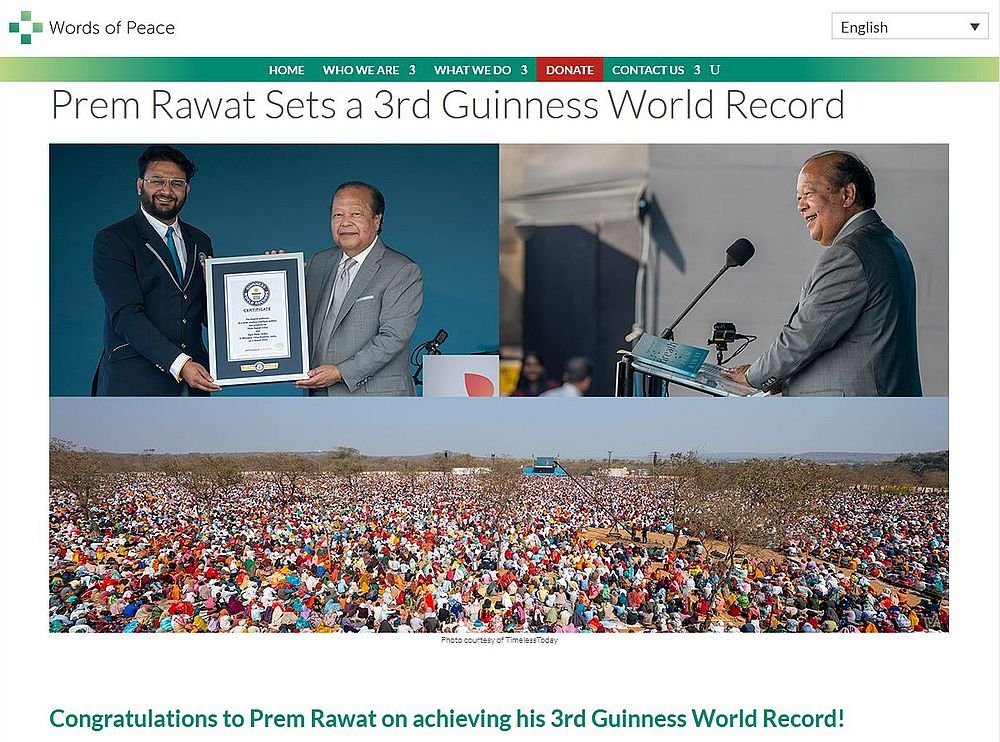
Prem Rawat holds the Guinness World Record for the "Largest Attendance at a Lecture".
What does this World Record mean?
The story lies less in direct rivalries with other public figures and more in how the category was created and how he beat his own record.
1. How the Category Was Created
Guinness World Records maintains thousands of highly specific niche categories. The record for "Largest Attendance at a Lecture" requires very strict operational parameters to qualify—such as an enclosed/fenced physical arena, scanned ticket/turnstile counts, independent adjudicators, and a single speaker speaking continuously for over 60 minutes on a unified subject.
Because these strict administrative criteria are usually organized specifically to claim a record, the main "competition" Rawat faced was the benchmark criteria set by Guinness and his own previous records:
April 2023 (Lucknow, India): Rawat set his first official Guinness World Record for a single lecture with 114,704 attendees at the Mata Ramabai Ambedkar Maidan. (a Maidan (in South Asia) is an open space in or near a town, used as a parade ground or for events such as public meetingss
November 2023 (Gaya, India): Seven months later, Rawat broke his own record by organizing a lecture attended by 375,603 people.
2. Why Other Large Gatherings Don't Hold the Record
There are many historical speeches, religious gatherings, and political rallies around the world that have drawn far larger crowds than 375,000 people (such as papal masses, political speeches, or events by Indian spiritual leaders like Sri Sri Ravi Shankar or Baba Ramdev, which pull millions).
However, those events do not hold the official Guinness title because:
Strict Category Definitions: Events organized as "religious festivals," "rallies," or "mass prayer gatherings" are classified differently than a formal, single-speaker "lecture".
Guinness Verification Costs and Logistics: To officially hold a Guinness record, an organization must pay for Guinness adjudicators on-site and build tracking infrastructure (like RFID turnstiles or fenced clicker gates). Most political figures or religious groups do not go through the formal application process to log a record for "single-lecture attendance."
Congratulations to Prem Rawat on achieving his 3rd Guinness World Record!
Sunday morning, between 9 am – 11 am Indian Standard Time, Prem Rawat (together with Vipul Rikhi) shattered a 25-year-old record for the “Largest audience for a book reading (with multiple authors)”.
The official audience of 133,234 surpassed the existing record by over 112,000. Harry Potter author, J.K. Rowling and 2 Canadian authors previously held the record of 20,264.
This marks another chapter in Prem Rawat’s bullshit. By Indian Guru crowd standards it's not a big deal
Thank you to Words of Peace supporters for your ongoing contributions in helping to make this possible.
India is home to some of the largest human gatherings in recorded history, primarily driven by massive spiritual and religious pilgrimages. Over the last 20 years, the largest single-day gatherings have all been associated with the Kumbh Mela and Ardh Kumbh Mela held in Prayagraj (Allahabad) and Haridwar.
The largest single-day congregations in India over the past two decades include:
1. The Prayag Maha Kumbh Mela (2025) – Prayagraj
Single-Day Peak: ~76 million (7.6 crore) people on January 29, 2025 (Mauni Amavasya)
Context: This stands as the largest single-day human gathering in recorded history. Over the course of the multi-week festival, an unprecedented total of roughly 660 million (66 crore) pilgrims participated.
2. The Prayag Ardh Kumbh Mela (2019) – Prayagraj
Single-Day Peak: ~50 million (5 crore) people on February 4, 2019 (Mauni Amavasya)
Context: Widely noted at the time as one of the largest single-day mass gatherings ever documented, bringing together tens of millions of Hindu ascetics and devotees for a holy dip at the confluence of the rivers Ganges, Yamuna, and the mythical Saraswati (Triveni Sangam).
3. The Prayag Kumbh Mela (2013) – Prayagraj
Single-Day Peak: ~30 million (3 crore) people on February 10, 2013 (Mauni Amavasya)
Context: This 12-yearly Purna Kumbh Mela drew a multi-week total of over 120 million people, marking a massive logistical milestone for temporary tent cities and crowd management at the time.
4. The Haridwar Kumbh Mela (2010) – Haridwar
Single-Day Peak: ~10 million (1 crore) people on April 14, 2010 (Baisakhi / Shahi Snan)
Context: Held along the banks of the Ganges in Uttarakhand, this major cyclical event recorded single-day surges of roughly 10 million, contributing to an overall festival attendance of around 70 million.
Other Notable Large Gatherings in India (Non-Kumbh)
While the Kumbh Melas hold the absolute records for single-day peaks, other massive recurring or cultural events in India draw tens of millions over multi-day periods:
Durga Puja in Kolkata: While spread across 5 to 10 days rather than peaking entirely on a single calendar day, cumulative local and tourist foot traffic in Kolkata routinely exceeds 30 million people visiting various pandals (temporary shrines).
Attukal Pongala (Thiruvananthapuram): Recognized by the Guinness World Records as the largest congregation of women for a religious festival, drawing millions of women cooking ritual offerings on a single day across the city streets.