Don and John Patterson podcast
We're talking about the cult leader Prem Rawat.
D. Edwin Johnson
August, 2026
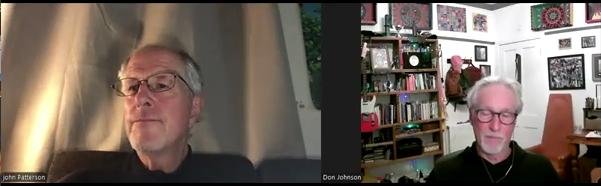
Don: Okay, so welcome to the show here. This is Living a Conscious Life, the podcast. And my guest today is a guy named John Patterson. And I will let John tell his story a little bit. And John is the brother of Bill Patterson. Many of you watching this may recognize that name. And John, I just want to say thank you for joining us and welcome.
John: Oh, it's my pleasure.
And, John, you were telling me that you don't live in the United States right now. You live somewhere south of the border.
John: Yes. I've been over the last five years, I've been traveling the world looking for an exquisite place to live from Tbilisi to Novi Sad to everywhere, Quang Thanh. And I now live in the highlands of Panama. And that was never on my radar. And it's just kind of amazing how I ended up here. But it's exquisite. It's a very, very beautiful place. And a third the cost of the US. And I'm retired. You know, I'm living on my social security. So it affords me still to travel and live a really, really good life.
Don: Wow. That's fabulous. You know, so you and I kind of just met in the last, gosh, week or so, I guess. Maybe we knew each other from the 1980s. We're not quite sure. But, you know, you reached out to me and you sent me a couple of nice notes. And I posted a little bit of what you told me on Facebook just recently. And it was a moving note. And it was a moving note you sent me because you talked about how you and your brothers and sisters got involved with Prem Rawat back in the day. You told a little bit about the history of how Bill Patterson, your brother, got involved. And you talked a little bit about your involvement in Miami during the heyday of the Boeing 707, the Broad Ripple, etc. And it was just all very intriguing to me. And I just would love for you to share with us, you know, your story, your journey, what you saw, what you were part of, how you went through it all and how you found yourself, you know, on the other side of the fence now in terms of your life with Prem Rawat. So, the floor is yours.
John: Well, it started long ago. Yes, my brother Bill Patterson was for many years very, very close to Prem Rawat. And his story is pretty incredible. And it began. First of all, my brother, we lived in Durango, Colorado. He was a very exceptional person. He was class president. He was a star athlete, super smart. I mean, everything he touched, he was just the best of the best. And so, eventually, when he graduated, he was accepted to Stanford, which is a very top university. He was there for a year or two. And then something unusual happened.
Stanford decided to try something quite unique. They chose a small group of students and their professors. And they thought, what if we sent these people to Austria, put them up in a small castle, and let them continue their studies there? I mean, what would happen if you took these ultra bright people, send them to Austria? So, that's what happened.
And at the same time I was traveling, I was hitchhiking through Europe. I was just a teenager. I'd go out every morning and stick out my thumb and away I went. And I happened to be in Austria at the same time that my brother arrived with this group of students. And I met him one day. I messaged him and met him one day. And I walked into the room and he was sitting very quietly. He didn't notice me entering. And he was staring out the window. He seemed like he was just very, very quiet and very pensive. And I said, hello, how are you doing? What do you think of Austria? And he was just really quiet.
And then he just announced to me, he said, I just want to let you know that I'm leaving the program. I'm quitting. I have decided to go. And the next day he left. And we were all shocked. Professors were shocked. Everybody, you know, here was a dream assignment. And he walks away. And he went back to the US, got some of his things in order. And then he started to walk the world, looking for something more unusual or incredible than just being a student in Stanford. And so he went back and then he started walking across Europe. He walked across Afghanistan. And his goal was to reach India.
He thought that he had heard that that is the spiritual place to be at that time, in the early 70s. And at the border of India, he met somebody named Charles Cameron. And Charles Cameron said, oh, whoa, that's amazing. Well, if you're going to do that, let me give you an address. Because if you're looking for the Perfect Master, I know where he is. So Bill was like, whoa, what a coincidence to meet somebody at this little border house and be handed an address. So Bill continued walking across India. He eventually went up to the highlands near the Himalayas, near a town called Dehradun. And he knocked on this door of the address. The door opened and it was this young, very young boy at that time. And it was somebody named Prem Mawat. He was just the son of somewhat of a Perfect Master of the time. His father was an important religious figure in that area. And Prem just said, "What took you so long?" And that impressed Bill. So he spent some time there.
And then he came back to the US and he started telling this story. And he went to various cities, Kalamazoo, and he just, he had "received Knowledge," this thing called Knowledge from Maharaji, who he eventually became known as Maharaji. And Bill wanted to spread the word. So he was given the job of walking the world and telling people about this amazing, amazing story. And he ended up being a very close associate to Prem Rawat. And he, his mission was literally to tell everybody about this Knowledge that people need to have. So that's what he did. He started talking to groups of people and many people met him and many people knew him from those close encounters. And eventually Maharaji came to the US as a young man.
One of the first places he went was Denver. And I was living in Denver at the time. And on Race Street, there was that famous house where he lived. And we came and we arrived and it was quite crowded and busy and everybody was excited because here he was in the United States. And we had programs every night where we would have something called satsang, which was talking about the truth and the light and the Knowledge that this young man revealed. And so many, many people started to join our organization. (laughs) Where do I go from here? A few years later, I was heavily involved in the organization and I moved to Miami because Prem had moved there and I wanted to be closer to everything. And I lived in a hotel called the Broad Ripple.
Many people remember that hotel, it's no longer there now. And we did everything we could to spread this message. And I became vice president of an organization called Divine United Organization. And it was kind of an organization that handled some of the financial aspects of the whole Mission. And I also was involved with a company called ProTech Security, which did security for Maharaji or Prem. They're on Alton Road. And I was a salesman and I went all over the place selling high tech security systems to places like the Miami Herald and the hospitals and Miami Decorating and Design Center. And I was quite successful. And we were just this ragtag group of people doing security sales.
But our main function was to protect the young guru or Maharaji. That's what we did. So everything that we earned, I wasn't, I didn't have a salary, I wasn't paid. I lived in an ashram, everything was taken care of. I was given a car because I had to travel. And I kept making sales and we sent all the money we made to the organization. And one of my jobs was to collect money that we had various fundraisers. At one point, it was announced that the young Maharaji wanted to buy a 707 plane. He thought he needed one. So we had a worldwide donation drive. A lot of money came in cash. And one of my jobs was to take that cash, carry it in large bags to a local bank in Miami.
And I had a nice relationship with a teller, a nice young lady. And she kind of looked at me like, what's going on here? You're walking in every once in a while with large bags of cash. But you seem like a really nice guy. You don't seem like it's coming from you kow the cartels or Escobar or somebody like that. And she was quite curious. And I was just cheerful and walk out with a deposit slip. And then in a few days, I'd be walking back in with loads of cash. And of course, that's how we financed some of the projects. And Maharaji, at that point, was living in a very fancy estate on one of the islands there in Miami Beach. And we provided security for that. And it was quite a life.
Don: Okay, hold on a second. You got my attention here. So I was in Miami too at that time, right? So this was, you're right, and Pablo Escobar lived on Miami Beach at that time. And the cartel, you're not exaggerating, right? So here it is, like, you're bringing bags of cash into some bank in Miami, like, literally bagfuls. Clearly, it was more than $10,000. And you're giving it to this person. And then, basically, that was probably highly illegal for a bank to accept sackfuls of cash. But somehow, that was happening. And that was part of your job. And then I assume that once you deliver these bags of cash into the vault or whatever, that was probably the last you ever saw of it, right?
John: That's right. Because I didn't have any money. I had enough if I had to travel or, you know, I had a lot of clients in the area. I had a meeting once with Julio Iglesias. He had heard that we were doing security. And if he ever visited our office, he would have gotten in his car and driven away quickly because it was above this bar on Alton Road. And we had this two-room shack on the second floor. And that's where Protech Security was. But I had a nice suit. And I was nice and I was a great salesman, no high pressure. And, yeah, I mean, bringing bags of cash into the bank, I still don't know to this day why they let me do it.
Don: Yeah.
JOhn: I just told them, well, here's the deal. Here's what the money's coming from. And I think probably this is the reason why they allowed it. I said, I'm a member of this organization, a religious organization. Every once in a while we have festivals and we have various fundraisers. And this is how I get this money. And they said, well, that sounds good. That's fine
Don: Amazing.
John: Yeah. Amazing. Yeah.
Don: So our paths, we don't, as we said earlier, I was in Miami at the same time. I was also doing fundraising. I don't think I had suitcases, briefcases full of cash. And I passed those to somebody from Prem's Office of Legal and Financial Affairs. I'm still curious about where it went. I have no idea. Nevertheless, there was a lot of cash flying around. We can both agree to that. And so you may have also crossed paths with maybe Michael Detmers or some of his attorneys that he used to use and that sort of thing. There was a lot going on in Miami at that time. Any other individuals that you bumped into that might have been part of the, I don't know, what would you call it? Prem's inner circle, I guess you could say.
John: Well, yes. Well, of course, my brother was one of the top people that was with Maharaji a lot. I mean, when we had festivals, we'd have these peace festivals, like up by, you know, all over Florida, where thousands of people would come to hear about this young Perfect Master that is offering peace to people. And, you know, I eventually, I was good friends with one of Maharaji's or Prem's attorneys. His name was Virgil Chulo. And he and I were quite close. So he was, he knew everything that was happening because he was handling all the legal affairs. But we lived in the same Rod Ripple Hotel, and we became very close. For many years, we were very good friends. And eventually we both moved to Denver, and he and I continued our relationship.
Don: Yeah, I knew Virgil just a bit, but you knew him more than I did for sure.
John: So between him and me and some others, we were quite knowledgeable about everything that was going on. And it seemed fine to us, you know.
Don: What do you, you know, for the person, people that are listening, many of whom, you know, may not have been there during those years and so on. What kind of things were you aware of then that were going on that you thought were normal, okay, but now looking back on it, you kind of might scratch your head and go, hmm, that didn't, that's not quite right. You know, is there anything that's struck you as that would fit into that sort of box?
John: I think the main thing that started to affect me was what this money was being used for, like 707 jets, and Jensen interceptor cars, and extremely large mansions, and all of this stuff. And I'm going, you know, why does a Perfect Master need a 707? And coincidentally, it only lasted a few days or a few weeks. I think it flew a few times, and that was that, but we paid for it. You know, and I just started to hear some stories, and I was a little bit, I was concerned that this whole peaceful, serene thing that we were supposed to be experiencing was actually fueling something that was quite not peaceful and not serene. And so, and eventually, Maharaji moved to Malibu. I think he still lives there.
Don: Yes, he does.
John: I don't think his wife is still with him. Some of his kids are, some of them aren't. But there again, you know, we were raising all of this money so that he could live high on the bluff above the ocean in this ultra, ultra expensive and beautiful residence. And I'm going, I've given up my life. I don't have a salary, I don't have any money, and I'm working day and night to support somebody that quite possibly doesn't even care about me. But I really wanted to experience something called Knowledge, something called peacefulness, something that you could walk around every day and just feel this incredible life force inside of your body. So that's why we all did it. And then eventually, at some point, of course, I decided to leave the organization.
And my brother Bill also left the organization after much time in the Malibu situation. He got a little bit, he got really disgusted with the lavish parties and the super expensive cars and you know, Bill would fly around the Pacific in the helicopter that we had purchased. And he just started seeing that, wait a minute, what is this? So he left. But unfortunately, because of that, he had invested so much energy and so much hope, and traveled all over the world talking to huge audiences. That he, it kind of shattered him to finally say, you know, I don't want to have anything to do with this anymore. And he, he never really recovered. He ended up living in this small dome, west of Boulder in Colorado. And he lived there for years, we didn't hear anything from him. And he just became a recluse.
Same thing with my sister. She gave everything to the whole movement and she totally fell apart. They were never able just to walk away from it and say, "Well, maybe we made a mistake. Let's get on with our life." And my sister, very beautiful young lady, very smart. She actually went to a university that Barack Obama went to, Pepperdine. But, you know, eventually she ended up on the streets of Denver, I remember. And I lived there at the time. And she was just never able to admit that maybe it was a mistake. And she eventually, you know, I'd find her laying on the streets. I'd find her behind by behind garbage cans, sleeping in the snow. I eventually got her into a facility in Brighton, Colorado, that took her in and a few years ago, she passed away. She never recovered.
And to this day, I don't know where Bill is. I'm sure somebody knows where he is. I don't know if he's alive. I don't know what's going on, but I haven't heard. My life continued. It didn't affect me negatively. I still was in sales. I worked for various companies. And I'm a great salesman, zero high pressure, made good money, happy. I'm living in a beautiful place now, one of the most beautiful places in the world, the highlands in Panama. So that's my life. I don't regret it. I was sincere. It didn't turn out. But you know, I just walked away and said, well, pretty amazing experience. But here I am today, healthy, 77 years old, a lot of things I know. But I just feel, I just feel thankful for being free and clear and happy.
Don: Yeah. John, thank you. There's lots of little questions bubbling in my mind listening to you know, it's a poignant story, you know, I mean, there's the, there's your journey and your, you know, total dedication to Prem.
John: Right.
Don: You had that I had that many, many of us had during those years. I think we were, you know, we were young. We're in our 20s and heading, heading towards our 30s by the, as we moved into the 80s. And, you know, I think we, um, we, we were very hopeful. We believed, we trusted. And then as some of what was going on, as you mentioned, the excess of the lifestyle, which at first, I think we looked at it was like, well, hey, he's the Perfect Master, ???, we're going to give him all this stuff.
He should have that, you know, I was part of like, you know, fundraising to buy him that first car and you probably were and all that stuff. And it seemed like, well, you know, you know, this isn't, you know, I'm not in a cult. The Moonies are a cult. Scientology is a cult. Krishna's a cult. I didn't think I was in a cult, you know, and well, he's the Perfect Master. He should have all this stuff. And then, you know, then there was maybe little cracks and, you know, and maybe I had, you know, I've taught, I'm not going to talk about my story too much here, but I had my own little cracks. And maybe there were cracks in your story where you saw the, you know, the Jensen.
Actually, there was a guy, I didn't sell the Jensen when it was in my, but somebody that I worked with sold that Jensen. I remember it came up, you know, Dettmers came to me and said to this, one of my colleagues, you need to sell this Jensen, you know, it was a beautiful car, you know? So anyway, but, you know, maybe that was a crack and, you know, and Bill, you know, and Bill, I met Bill in Kalamazoo in 1972, apparently right after, you know, he came back and was, you know, proselytizing and doing his thing, you know, and I, he was an influential guy to sort of point me towards Receiving Knowledge. And we sat in a little Victorian house in Kalamazoo, Michigan and, you know, and I knew Bill for many years after that.
So then he goes out to Malibu and here he is. And, you know, Bill Patterson was the guy who would, he was like the keynoter at a lot of these big events that we would go to it, Kissimmee or Hans Jayanti or Guru Puja, all these things. Bill Patterson was like the major guy, you know, first American Mahatma and all this. Now he goes out to Malibu and he's flying around in the helicopters. Sounds like he was exposed to all the parties. I don't know, maybe the drugs, the alcohol, I don't know, whatever was going on out there.
And it must've just twisted his head around and, you know, and then how do you, and for some of us, like, how do you make sense of the fact that when we began this journey, we thought that our whole, everything in our life coalesced to this point where we maybe met Charles Cameron at a little hut in the border. Maybe for me, it was, I met, so I crossed paths with somebody. Maybe it was something different for you. But, you know, we believed, I think at the time that following Prem Rawat was our destiny because he could help us achieve peace. But what we soon found out later was he couldn't even bring peace to himself or to his family or to his children. And yet, and now we have to make sense of how do we make sense of this turn of events that seems so amazing. And then we start to learn about what was really going on behind the scenes. And I guess perhaps what happened to Bill, and maybe it happened to you to some degree. Some of us could walk away easily. Some of us, like Bill, maybe it was much more difficult.
John: Right. And I'm also very interested in, you know, there's things happening with other religions, too. There's a lot of Jehovah's Witnesses here in town here, and I've spent hours talking to them. But it's the same situation. There's some people that are coming out online just talking about the crazy stuff that's going on, or the Mormon people, the people that are leaving the Mormon religion. Religion's just, and then last night I was reading about all these preachers, mainly back East U.S. that were multi-multi-millionaires. And the stories that are coming out from all the greed and the excess and, you know, they're now all debunked and thrown out of the church. But it involved millions of dollars. And it wasn't just Divine Light Mission. It's still happening all over the world. And you just have to be really, if you're a truth seeker, you just have to be careful that you're not being manipulated. You have to, you know, you have to follow your heart.
Don: Yeah. And the thing is, for me, I thought I was following my heart, you know, and I gave my heart, you know, to, for example, in my case, you know, Prem Rawat. And then, you know, when I heard about some of his lifestyle, I had a little doubt in my mind. I thought that's kind of strange, doesn't quite jive. And I ignored my intuition. And then later, many years later, when I read about his behavior, Michael Dettmer's postings in particular, who I worked for during those years in Miami, then I looked and I thought, you know what? My intuition was correct. My intuition was telling me there's something wrong in River City, as they say. And now I look back on it and say, you know, yeah, my heart was telling me something, but there was also something else going on. And I pushed that aside and continued for a certain period of time. And then I was able to separate. So I'm curious, just also for you, like mentally, did you have to do any mental gymnastics, you know, to unpack things, to say, well, how do I make sense out of this? Because what I thought was so real, now I look at it and go, well, maybe the inner experience was real. For many people, it was and is. And yet the sort of the belief in Pram Rawat that seemed so real, then something happened, you have to sort of undo that. What was that like for you to kind of come to terms with the fact that you might have been actually fooled?
John: Well, it became quite clear to me that I'd been fooled. And it didn't take me long to walk away. I didn't go through a huge struggle. I didn't have to go to multiple psychologists or psychiatrists to talk it out. I just said, well, you were sincere. You wanted to improve your life. We're only on this earth quite possibly once. And I wanted to, I wanted a beautiful, beautiful experience. So, it didn't, I just walked away and left the baggage at the border. And whoever has gone through that stuff can have it. But I didn't want to spend too much time moaning and groaning and going, well, woe is me. I just got on with my life. You know, I go out and ride every morning here in the highlands of Panama. And it's so beautiful. You can't conceive of it. I ride for an hour every morning on my bike. And I just give thanks for being alive to, for all the experiences that I've had, the good, the bad. I'm just happy that it didn't wipe me out psychologically, and I didn't go into decline. I'm very thankful for that. And I'm, I'm looking forward to each day. And I, obviously, we probably all learned some important things.
You know, it wasn't all for naught. We learned about maybe giving part of your life to pursuing something higher, rather than just, you know, I have a beer every once in a while, usually a good German beer once a week, but that's about it. You know, I don't struggle with that. I don't struggle with anything. I just, and maybe it's quite possible that I did learn something in that whole experience, that I did experience a knowledge that I didn't have before. And it's quite possible that I'm living with that now. And that intrigues me. And I'll take it. I like it.
Don: Yeah. No, I get that. I mean, similar in my case, where I got to a point where I said, you know, the teacher is one thing, the teachings are something else. And the teachings are actually not his anyway. The techniques are ancient. You know, he kind of put his arms around them and sort of claimed them as his in our world. And yet, when you go beyond our world, those techniques were around, they were used by other yogis and other situations. So, you know, we were practicing something, which was basically a method for us to, you know, go within, slow down, experience an inner experience. I benefited from that, just like you did, perhaps. And for me, I had to come to terms with the fact that there were many things that I learned, many experiences that I had.
I traveled the world, John, when I was in my 20s, as a instructor, Europe, Africa, Australia, New Zealand. Yeah, it wasn't all bad. And I've never in all the articles I've written, I've never said, Oh, it was all terrible. No, it wasn't. I learned a lot. I've developed the ability to public speak. I became a facilitator later in life that I drew upon my experience in terms of giving satsang every night and speaking and all those sorts of things. Those were incredible things that were learned. Yeah.
And this is where I draw the line, which is this, I put in the work, you put in the work. And from that, we benefited, somebody benefited, it was me. And there was this other school of thought was, well, it was the grace of the Perfect Master that enabled me to have this experience. And I believed that for a while. And now I think, you know what, that's a pile of horse manure. So that was the belief, though, it was emanating from Prem Rawat.
And that's the tragedy of the whole thing, is him claiming and demanding that we worship him and give ourselves to him, because he is the one that has come to earth to do this and to do that and all this nonsense. And what we really find is, wait a minute, we have what we need within us. And when we tap into that, we develop our own self, our own sense of power, our own sense of responsibility. We take ownership for the choices that we make. And, you know, you and I made a choice to join the ashram. Nobody twisted our arm to join. I volunteered, you know, I walked into it. I said, I'm all in, you know. And so, you know, we, you know, maybe that's one of the important lessons that we learn is how to take ownership for our choices, how to be responsible for our own decisions, and how to make peace with that.
And, you know, that's one of the things that, you know, has slowly, I mean, some people, like you just walked away. I sort of drifted away. Other people walked away. Other people had a much choppier journey to untangle themselves, because we're all different, how we're wired. But, you know, I really do appreciate the fact that, you know, what you're saying is, you're grateful, you wake up every day, you're happy to be alive. You're thankful you've got good health. I mean, these are beautiful things, man. Not everybody has them. You know, and, you know, just while we're on this podcast, and people are listening, you know, there's people like, for example, that people know, a beautiful soul, Arthur Brigham, just passed away about a month ago.
A beautiful man. Another woman in Australia, I think her name is Cathy Ann Quayle, who I knew just briefly. A beautiful woman just passed away. Other people have just passed away. So, you know, Michael Dettmer's passed away, a guy who gave himself totally to Prem Rawat for many, many years, you know. So, you know, here we are, we're still talking, you and I are above ground, and we're, you know, we may not, we don't know how long we're going to be here, but we're here now, and we're appreciative of our life. And I love that spirit that I feel from you about being grateful.
John: Another thing happened to Bill earlier, early in his life, we had a grandfather who was a preacher, and he was really intense. He was terrible. He just, everything was hell, and you're going to go to hell, you're going to go to the hell. And he would invite us into the room, like when we're eight or nine years old, and say, you know, he invited Bill in first and said, have you ever missed Sunday school? Bill said, yeah, we went skiing a couple weeks ago, and we didn't go to Sunday school. And my grandfather looked at him and said, you will go to hell, and you will burn in the fire of hell forever and ever, because you didn't go to Sunday school.
And that was his ministry. And then I walked in, and he said, have you ever missed Sunday school or going to church? And I said, yeah, every once in a while we go skiing, and he leaned forward and he said, I just want you to know that when you die, you will go to hell, and you will suffer forever and ever. And I looked at him and I said, hey, see ya. And I stood up and I walked out. It didn't affect me at all. It's like, this man's crazy. But Bill, for his whole life, struggled with that. You know, that whole thing of not being good enough or going to hell or religion. And to me, it was a profound experience for him. It was not profound for me.
And, you know, and maybe that's one of the reasons why he struggled, you know, was that upbringing, that programming, that heavy-duty Christian guilt or shame or burn in hell, that whole thing, to have that in your psyche. And then you walk in and now you've got the Perfect Master. You're close to him. And then you find out he's doing this, he's doing that, all the various things that we know about. That must have just ripped him to shreds. That's my guess with that.
Yeah, I just want to say to all the people in the world that have been trampled by their religion and have experienced some terrible, terrible things, I mean, from priests molesting kids, I just hope that someday you could just walk away and say, you know, that didn't have anything to do with me. That was just a crazy thing. And just go on with your life. But for so many, they're traumatized forever.
Don: Yeah, there's a lot of trauma in all that. I mean, from the people that I've spoken to, victims, the trauma goes deep, deep, deep. It really, really does. I think it's impossible for any of us who have never been molested to understand what that does to a human being. You know, it's just, it's inconceivable.
John: You know, I just want to say you just need to walk away because it's beyond deadly.
Don: Yeah, it's, yeah, it's, yeah, it's a tough one, man. It's a real tough one. So, yeah. But, you know, this is, you know, this is the, when you talk about, as you say earlier, what we're experienced, what we've experienced with Prem Rawat is not, we're not alone in terms of the impact of these corrupt spiritual leaders in various churches, religions, and so on, as you say. We see it happening throughout the world. And, you know, this is, this is one of the things that, interestingly, when we joined Divine Light Mission, there was a big thing about the fact that, wow, this is not a religion. And, you know, we're not, we're not a religion. We're not a cult, all these kinds of things. And then, as it turns out, well, you know, what is kind of like a religion is a cult. It fits every definition of a cult. And, you know, we walked into the fire and we were able to walk out, you know. And so, yeah, we count our blessings.
So, Amazing. What have I not asked you that I should ask you? Or what have we not discussed that you might like to kind of say before we close this up? Because we've been talking for about 40 minutes or here. So, is there anything else you'd like to add, John?
John: Well, it's just kind of amazing how I ran into you, obviously. Three or four days ago, I just, out of nowhere, I just started thinking about Maharaji. And I don't know why. It just popped into my head. So, I thought, I jumped on the internet and did some research and what's he doing now and this and that. I was just curious. And your name came up somehow. And I just sent you a message because I knew Bill and I knew a lot of the stuff that was going on. And I've never really talked about it. And that was kind of amazing how that happened.
Don: Yeah.
John: But I'm not going to bother you constantly. I'm a peaceful kind of guy.
Don: You're not bothering me. No, look, this is the thing. Your story is really unique. And you talked about Bill. And as I mentioned to you, I have a friend in Boulder who's going to do what he can to see if he can locate Bill.
John: Yeah. Somebody knows where Bill is or what has happened to him. And we just haven't found that person. No, not yet.
Don: But we're going to do what we can and hopefully we find Bill. And when I hear back from my buddy, I'll report back to you and we'll see what happens, man. Listen, thank you very, very much, Mr. John Patterson. It's been a pleasure. And if there's anything, as you start to reflect on this or whatever, if you've got other stories that you want to share about your journey, please let me know. We can do podcast number two.
John: Yeah.And I probably didn't cover everything in this podcast, but I did my best.
Don: You did fabulous. You're a well-spoken man. And I appreciate that.
John: I'm just I'm a happy camper. I mean, I'm very thankful for my life and my experiences. I've been very, I've been taken care of. Yeah.
Don: Pleasure, John. Thank you. Have fun.